
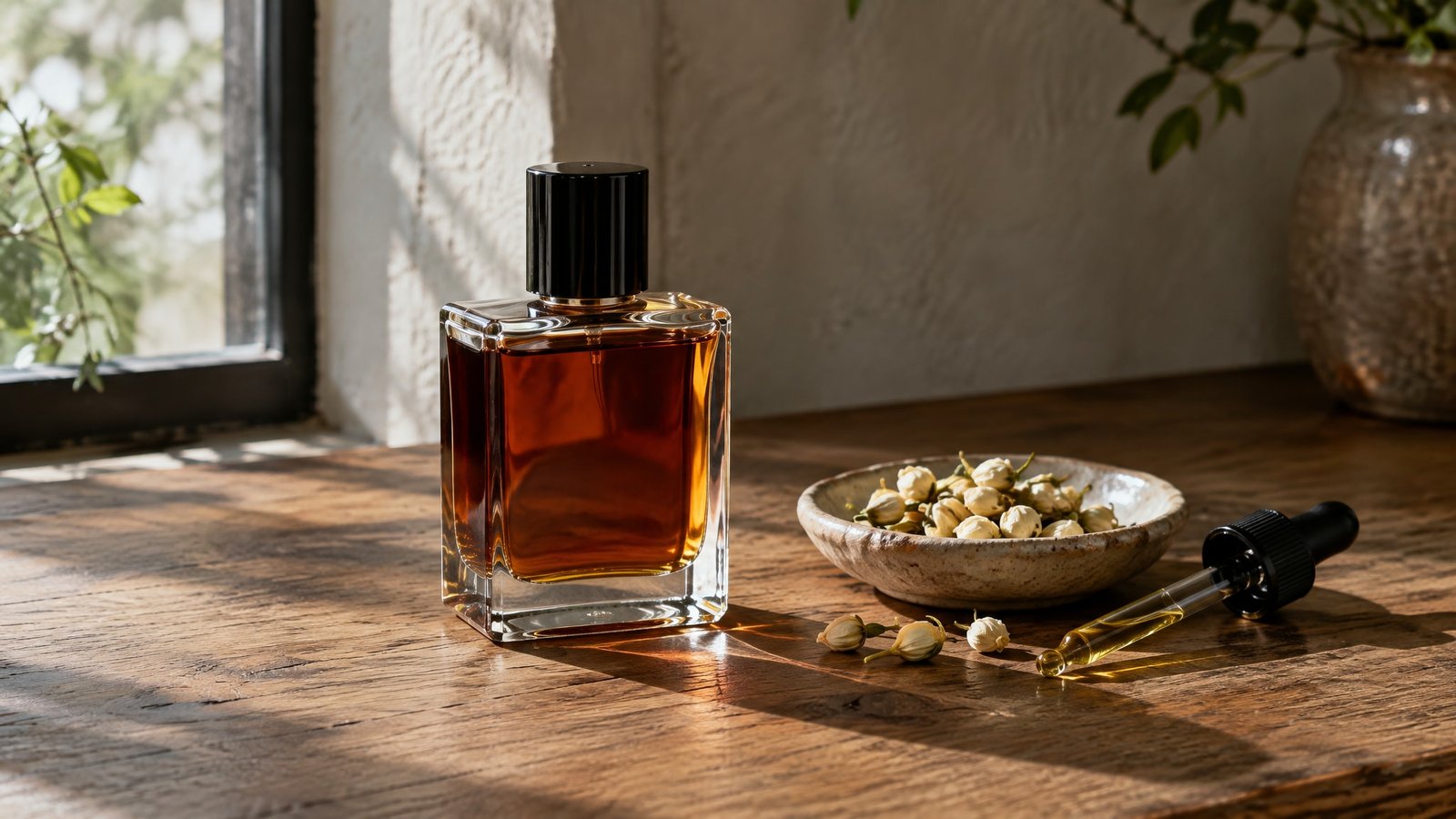
Every bottle carries a small label that most of us skim past: eau de toilette, eau de parfum, extrait de parfum. Those words are not decoration. They tell you how much of the bottle is actual fragrance, and that shapes how a scent opens, how it settles and how long it keeps you company.
If you are weighing an extrait de parfum against a typical eau de parfum, this is the plain-spoken version. No chemistry lecture, just what you will notice on your own skin.
Perfume Concentration Explained in Plain Terms
Concentration is the share of fragrance oil in the liquid. The rest is usually alcohol, and sometimes a little water.
Think of it as a ladder. Eau de toilette sits on the lower rungs, eau de parfum sits in the middle, and extrait de parfum stands at the top of the common labels. As a rough guide, houses often place an eau de toilette somewhere around 5 to 15 percent oil, an eau de parfum around 15 to 20 percent, and an extrait at 20 percent or more, though the exact lines differ from house to house.
Here is the part people miss. Dose sets strength, not origin, so a natural scent and a synthetic one can sit on any rung of that ladder.
At Old World Fragrance, founded by Robert Comitz with 45 years of fragrance-making behind him, the line is built around extrait de parfum and made from flower absolutes, tree oils and plant extracts. Those natural materials follow the same rules as any perfume, and you can read more in our guide to natural extrait de parfum.
Concentration tells you how much oil you are wearing. It does not tell you how good the oil is.
Fragrance Notes Explained: How a Scent Unfolds on Skin
A fragrance is not one smell but three, arriving in order. Top notes are the bright first impression that fades within minutes. Heart notes form the middle of the scent and give it its character. Base notes are the deep, slow materials that carry the scent after the opening has gone.
Perfumers have long leaned on base materials such as sandalwood, musk, ambergris and patchouli to anchor a composition and slow its evaporation, which is why the base shapes how long a scent lingers. It is also where concentration shows most, because a richer dose gives those heavy materials more to work with.
Base Notes: The Natural Materials That Anchor the Scent
Sandalwood comes from ancient trees in India, Hawaii and New Caledonia. Its aroma is warm, calming and grounding, the kind of quiet elegance that settles over the skin like a soft wool wrap.
Musk Fragrance is sourced from the highlands of Tibet. The copy describes a rich, warm, earthy aroma with depth and lasting presence, which makes it a useful reference point for what a base note feels like.
Ambergris Fragrance begins as one of nature’s rarest gifts, formed within the sperm whale and carried across the ocean’s surface. Sea and sun turn it into a fragrant, resinous treasure.
Patchouli fragrance pairs the rich, earthy depth of patchouli with the creamy warmth of vanilla and the grounding touch of sandalwood. It reads earthy yet sweet, bold yet comforting.
Heart Notes: Where Florals Show Their Character
The middle of a scent is where flowers do their talking. Jasmine Fragrance blends two of the most revered jasmine oils, each with its own essence, so the floral heart has two distinct characters to unfold. The result is sensual yet fresh, timeless yet modern.
Blue Lotus fragrance brings together white, pink and blue lotus absolutes. White lotus offers purity, pink lotus grace, and blue lotus a note of mystery, and together they feel calming and uplifting.
Extrait de Parfum and Eau de Parfum: What Changes on Your Skin
Spray both on clean skin and the difference arrives gradually, in the way the scent moves from the first breath to the last.
An eau de parfum often opens brighter and more noticeable, with its lively top notes arriving all at once. An extrait opens more quietly, as if it is in no hurry, and then settles into something smoother, richer and closer to the body.
The Opening Hour and the Settled Feel
In the first hour, an eau de parfum tends to announce itself. You catch it on your wrist, on your collar, in the lift of a hello. It is bright and cheerful, and many people love exactly that.
An extrait gives you less of a flourish and more of a slow bloom. Because the oil is dense, the transition from opening to heart feels softer, with fewer sharp edges. By the time it reaches its dry-down, the scent seems to melt into your skin rather than hover above it.
The settled feel is where an extrait earns its keep. What remains is warm and intimate, the sort of scent someone notices only when they lean in close.
Extrait de Parfum Longevity: How Long Each Concentration Holds
Here is the everyday answer. An eau de parfum generally holds for a good part of the day, while an extrait generally stays on skin longer. Both are tendencies, not guarantees, and your skin type, the climate and how much you apply will nudge either one. Dry skin tends to let fragrance fade sooner, and a warm day can make a scent bloom fast and burn off sooner than you hoped.
No honest perfumer can promise you a number of hours for a particular bottle, so you will not find one here.
How Long an Eau de Parfum Tends to Last
An eau de parfum gives you a lively morning and a pleasant afternoon, and then it begins to thin. The top and heart notes leave first. The base notes last longest, so what you smell at the end of the day is mostly the deepest materials, softened.
If you like a fresh application before an evening out, an eau de parfum suits that rhythm well.
Why an Extrait Tends to Last Longer
An extrait carries more fragrance material, which means there is more on your skin to evaporate over time. Nothing sudden happens. The scent simply has further to travel before it disappears.
That is why a base-heavy extrait, built on materials like sandalwood or ambergris, can still be felt close to the skin long after an eau de parfum would have faded. This is not a promise that it will outlast every other scent on every wrist. It is a pattern you can test for yourself over a few ordinary days.
Strongest Perfume Concentration: Projection vs Staying Power
The extrait is the strongest perfume concentration among the common labels, yet “strongest” is a slippery word, because it can mean two different things.
Strength Means Two Things: Reach and Endurance
Reach is projection, how far the scent travels from your skin and how much of the room notices it. Endurance is longevity, how long the scent stays with you.
An extrait leads on endurance. An eau de parfum can feel louder early on, because its brighter opening throws the scent outward in that first hour. So the most concentrated option is not automatically the one that projects furthest.
This matters when you choose for a setting. For a quiet office, a close-wearing extrait is ideal, since your colleagues will catch it only in passing and you will still smell it at your desk by mid-afternoon. For an evening out, where you want to make an entrance, an eau de parfum’s opening can do some of that work, though you can also apply an extrait to a few more pulse points and let it build.
If you are after a scent that fills a room within seconds of walking in, an extrait is not built for that.
Cost per Wear: Where the Value of an Extrait Shows Up
Sticker price tells you what you pay once. Cost per wear tells you what you pay each time you step out the door, and that is the number that decides whether a bottle was good value.
Each Old World Fragrance product page lists current size and price, so check there rather than relying on any figure quoted in an article. What matters here is the logic.
Why a Smaller Dose Can Cost Less per Wear
An extrait is dense, so a small dose goes a long way. A touch on the wrist and the side of the neck can carry a scent through a full day and sometimes into the next, which means you reach for the bottle less often.
A typical eau de parfum may need a refresh as the afternoon thins, so you spray again, and a larger bottle empties faster. Over a season, that adds up.
The edge is real but not automatic. If you apply an extrait generously, several heavy sprays every morning, you erode the saving, and you may overwhelm the scent too. The value depends on how often and how generously you apply it, so start small and add only if you need to.
Eau de Parfum vs Extrait: Choosing Your Concentration
Choose by the way you wear fragrance, not by which label sounds stronger. Neither concentration is the villain here. Each fits a different kind of day.
When an Extrait Earns Its Place in Your Routine
An extrait suits you if you want close, long-lasting wear, the kind of signature scent that is felt more than noticed. It belongs to people who apply once in the morning, forget about it, and are quietly pleased when it resurfaces at dusk.
It also suits those who care how a scent is made. When the line is built purely from flower absolutes, tree oils and plant extracts, a rich dose lets those materials show their full depth. If you are still searching for that one everyday scent, how to choose a signature scent is a good place to start.
When an Eau de Parfum Still Makes Sense
An eau de parfum is a fair alternative, not a lesser one. It suits brighter, more projecting days: a lively dinner, a warm afternoon when you want a lift, or any moment you want the scent to arrive a step before you do.
Many people keep both. An eau de parfum for the days that call for sparkle, an extrait for the days that call for calm.
When you are ready, let your own routine lead you to a note family. Reach for Sandalwood or the other base-note scents above if you want warmth that stays close, or the jasmine and lotus pages if a floral heart is more your way. Take your time, and let the scent that feels like you find you.
Frequently asked questions
How long does eau de parfum last?
An eau de parfum generally holds for a good part of the day, with the base notes lingering longest after the brighter top notes have gone. Your skin type, the weather and how much you apply all shift that. Dry skin and heat usually shorten it, and a slightly more generous application stretches it a little.
Which is better, EDP or parfum?
Neither is better across the board. An extrait de parfum suits you if you want a scent that stays close to the skin and lasts longer, while an eau de parfum suits brighter, more projecting days. Pick by how you actually wear fragrance, not by which label sounds stronger.
Is a natural perfume weaker than a synthetic one?
No. Strength comes from concentration, the share of fragrance oil in the liquid, not from whether the materials are natural or synthetic. A natural extrait made from flower absolutes, tree oils and plant extracts can sit at the top of the concentration ladder just as any other perfume can.
How much extrait de parfum should I wear?
Start small, with a touch on the wrist and the side of the neck, then add more only if you cannot smell it after a while. Extrait is dense, so heavy application can overwhelm the scent and use up the bottle faster. A light hand is also what gives you the better cost per wear.

Leave a Reply