
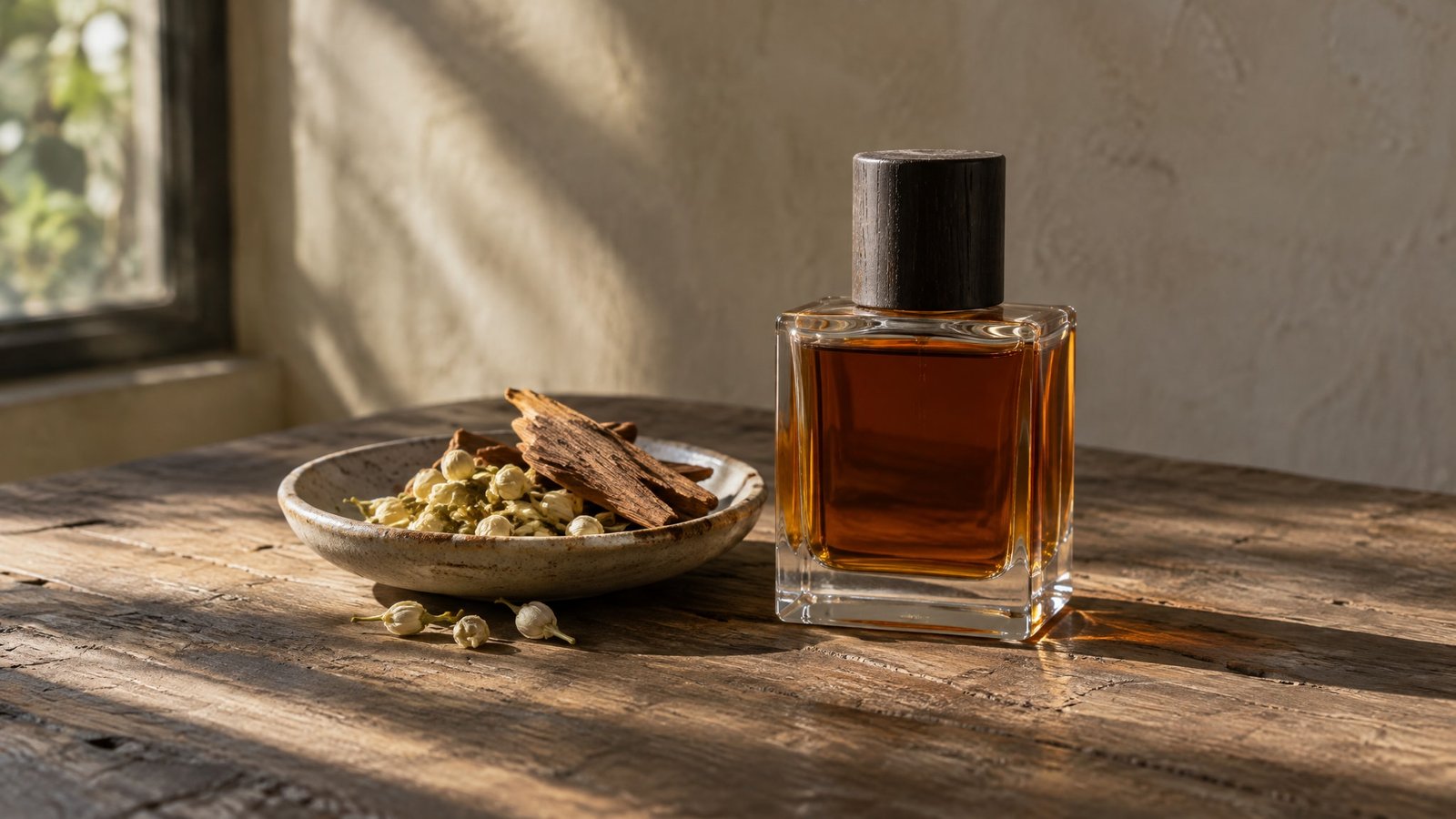
Open a bottle of a mass-market perfume and you meet the same bright, engineered blast everywhere. Open a bottle made from flower absolutes and tree oils and the scent behaves differently: it shifts, warms and deepens as the hours pass.
That difference is why the best natural perfume brands are worth seeking out. This guide shows you how to judge them, then walks through six extraits from Old World Fragrance, a small Pennsylvania house built on one perfumer’s 45 years of craft: jasmine, blue lotus, patchouli, sandalwood, musk and ambergris.
What natural perfume brands mean by “natural”
In perfumery, “natural” describes where a material comes from and how it is extracted. A jasmine absolute drawn from flowers is natural. A laboratory molecule built to imitate jasmine is not, however pleasant it smells.
That is a promise about source and process. It says nothing, by itself, about safety or gentleness, and this is where many shoppers get tangled.
Natural versus synthetic, and where “clean” fits
“Clean” and “non-toxic” are separate claims. They usually describe what a formula leaves out, such as certain preservatives or solvents, and they say little about what a scent is made from. A perfume can be labelled clean and still rely on synthetic compounds. Another can be built wholly from natural materials and never use the word.
Clean natural fragrance brands tend to blend the two ideas, so read past the label. If you want the longer comparison, our piece on natural versus synthetic perfume goes through it line by line.
“Natural” also does not mean plant-only. Some of the most prized perfume materials come from the animal world or the sea, and an honest house says so plainly. We return to that in the base-notes section below.
How to judge independent perfume houses and small batch perfume makers
Independent perfume houses and small batch perfume makers have no advertising budget to hide behind, so their openness is the whole story. Judge them on three things:
- A named founder. You should know who blends the scent and how long they have done it.
- Materials explained. The best houses tell you what is in the bottle: which flower, which tree, which region.
- A clear meaning of “natural”. Does it cover every ingredient, or only some? A good maker answers without squirming.
Compare that with the large, mass-market houses you already know. Their perfumes are built for consistency across millions of bottles, usually around synthetic compounds, and the person behind the formula is rarely named. A founder-led house like Old World Fragrance offers the opposite: one face, one philosophy, a short list of scents.
The word “natural” on a label proves little. How freely a house explains its materials, its process and its founder tells you far more, and it costs a brand nothing to be specific if it has the substance to back it up.
Old World Fragrance: 45 years of craft in niche natural perfumery
Niche natural perfumery is a crowded corner. Plenty of labels use the language of purity, and few can show you the person behind it. Old World Fragrance can.
Robert Comitz and 45 years of fragrance-making
Old World Fragrance is a custom perfume retailer based in Eastern Pennsylvania, founded by Robert Comitz. He has spent 45 years making fragrance.
Forty-five years is a long time to learn what a flower absolute does in the heat of a summer day, or how a tree oil settles once it meets skin. That patience is the house’s real differentiator, and no marketing campaign can manufacture it.
The brand sets itself against modern synthetic compounds. Each scent is made from natural flower absolutes, tree oils and plant extracts, the way perfume was made before the laboratory took over.
Imagine unhurried blending, a short list of fragrances rather than a catalogue of seasonal launches, and a maker who would rather perfect six scents than release sixty. That is the spirit you are buying into.
What the extrait de parfum format means for a natural scent
The extrait de parfum is the most concentrated style of perfume, which is why Old World Fragrance chose it. The extrait de parfum format carries a high proportion of aromatic material, so the scent has more to give from the first moment to the last.
For a natural scent, that matters in three ways:
- How it opens. Natural materials unfold slowly, so the first impression is rounder and less of a rush than a sharp, alcohol-forward spray.
- How it sits. A concentrated extrait tends to stay close to the skin, a soft aura rather than a loud trail.
- How it lasts. More aromatic material usually means the scent lingers and evolves through the day.
You do not need much. A touch on the wrists or the side of the neck is enough, because warmth from your skin coaxes out each layer in turn.
One honest limit: this is not a perfume for anyone who wants strong, room-filling projection. Natural extraits are intimate by nature.
Floral naturals: sensual jasmine and calming lotus
Flowers are where natural perfumery shows its range. Here are two Old World Fragrance extraits that take florals in opposite directions, one warm and sensual, the other still and serene.
Jasmine Fragrance
Jasmine Fragrance starts with a journey. The house travels to handpick two highly regarded jasmine oils, each with its own essence, and its perfumers blend them into a single scent: sensual yet fresh, timeless yet modern.

Using two oils rather than one is a craftsman’s choice, and it gives the scent more dimension than a single note could. If you love jasmine but find some versions heavy or sugary, this is the one to try. For a deeper look at the flower itself, read about pure jasmine absolute.
Blue Lotus fragrance
Blue Lotus fragrance gathers three sacred flowers in one calming blend. White lotus absolute brings purity, pink lotus evokes grace, and blue lotus inspires mystery.

Together they make a scent that is calming, uplifting and quiet, the kind you wear on a slow morning when you want to unleash your senses without any noise. Curious about the flower’s history? Here is the story behind blue lotus.
Earthy and woody naturals: patchouli and sandalwood
If florals are the bright side of the line, these two are the grounded one. You will find both are warm rather than sweet, and both suit anyone who prefers depth to sparkle.
Patchouli fragrance
Many people think they dislike patchouli because they have only met the dusty, heavy kind. Patchouli fragrance is a gentler way in.

At its heart lies the rich, earthy depth of patchouli, balanced with the creamy warmth of vanilla and the grounding touch of sandalwood. The brand describes each note as unfolding like a story, earthy yet sweet, bold yet comforting.
That balance makes it a warm entry point if patchouli is new to you, and a natural fit for a unisex patchouli perfume wardrobe.
Sandalwood
Sandalwood is the simplest scent in the line, and the simplicity is the point. The oil comes from ancient trees in India, Hawaii and New Caledonia and is carefully extracted.
What you get is a warm, calming aroma that perfumers have cherished for centuries. It is rich and grounding, and it brings a quiet elegance to an ordinary afternoon.
Rare, warm base notes for the finish of a natural scent
Base notes are what remain once the opening has faded, and they decide whether a scent is remembered. This is where the rarest materials tend to live, and where honesty about origin matters most.
Musk Fragrance and Ambergris Fragrance
Musk Fragrance is the pure musk of Tibet. The brand sources it from pristine highland landscapes, and describes an aroma that is rich, warm and earthy, treasured for centuries for its depth, elegance and lasting presence. If you want to read more about the note, see our guide to natural musk perfume.

Ambergris Fragrance is a different kind of rarity. The brand describes ambergris as one of nature’s rarest and most mysterious gifts, formed within a sperm whale and later drifting across the ocean’s surface, where the sea and sun transform it over time into a fragrant, resinous treasure.
Where musk is earthy and close, ambergris feels like salt air and warm stone. Both come from nature rather than a laboratory, but neither is a plant material, so if that matters to you, check each product page before you buy. Anyone wondering where to find ambergris perfume will find that route here.
Choosing your natural signature scent
All six extraits are unisex, so choose by mood and season, not by label.
- Jasmine Fragrance suits warm evenings and anyone who wants something sensual but fresh.
- Blue Lotus fragrance is for quiet, calm days.
- Patchouli fragrance is the cosy one, ideal for cooler months.
- Sandalwood works year-round when you want to feel grounded.
- Musk Fragrance and Ambergris Fragrance are for the finish: deep, warm and lasting.
Remember that a perfume unfolds in sequence. Top notes arrive first, then the heart, then the base, though this is a loose rule of thumb rather than a strict timetable. Your first spray is only the opening, so give any scent an hour on your skin before you decide.
Each extrait is priced at around USD 25, though that may change, so check the product page for the current figure. Natural materials can still irritate some skin, so test a small amount on your wrist first.
Whichever you choose, you are wearing the work of Robert Comitz and his 45 years of fragrance-making. Smell the jasmine, the lotus, the patchouli and the sandalwood, then let the musk and ambergris close the story. Indulge in the elegance of a scent made the old way, and explore the full perfume collection from Old World Fragrance.
Frequently asked questions
What is the best natural smell for perfume?
There is no single best smell, because it depends on mood and skin. Jasmine is sensual and fresh, blue lotus is calm and uplifting, sandalwood is warm and grounding, and patchouli with vanilla is earthy and cosy. Start with the mood you want to wear, then test on your wrist for an hour.
What is the 30/50/20 rule for perfume?
It is a loose rule of thumb about how a fragrance balances its top, heart and base notes, often quoted as 30, 50 and 20 percent. Perfumers treat it as a guide rather than a law. Old World Fragrance does not publish its formulas, so use it only as a way to think about how a scent unfolds.
Are all natural perfumes plant-based?
No. Natural describes where a material comes from, and that can include the sea or animal sources. Old World Fragrance describes its ambergris as formed within a sperm whale, and its musk as sourced from Tibet. Read each product page if origin matters to you.
Are Old World Fragrance perfumes men’s or women’s scents?
They are unisex. Each extrait is built around natural materials such as flower absolutes and tree oils, so you can choose by mood or season instead of by label.

Leave a Reply