
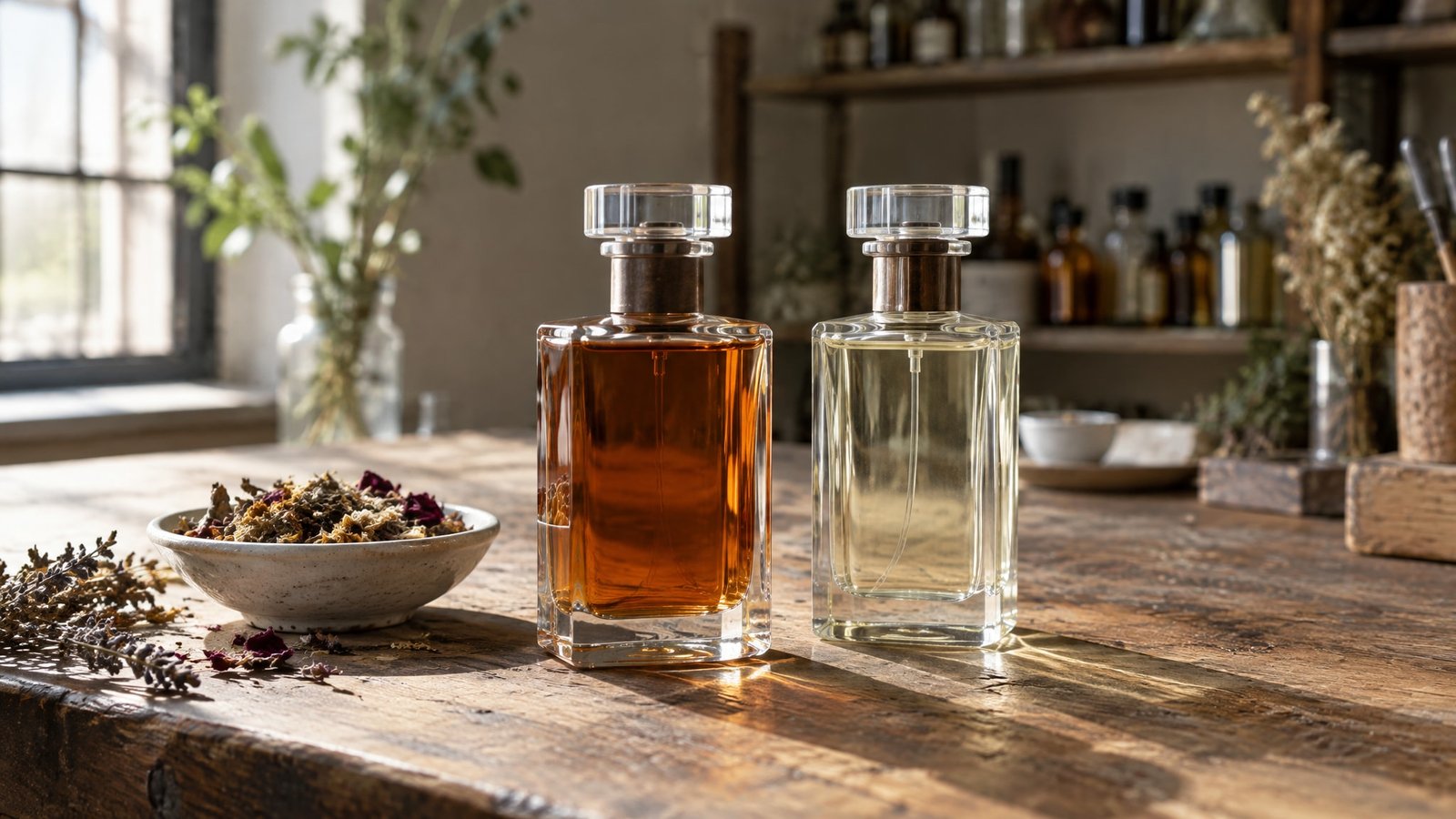
Pick up two bottles and the labels tell you very little. One says “parfum,” the other says “natural,” and neither says what the scent is actually made of. This guide sets natural perfume vs synthetic perfume side by side in plain terms, so you know what you are putting on your skin and why it changes how a fragrance feels.
Natural perfume and synthetic perfume, defined
A natural perfume is built from materials that come straight from the natural world: flowers, woods, resins and, in older traditions, a few animal-derived materials such as ambergris and musk. A synthetic perfume uses aroma chemicals, which are molecules made by chemical synthesis in a lab.
Most perfumes on the high street blend the two, and many lean heavily on the synthetic side. The history of perfume shows how long perfumers have worked with both.
Concentration is a separate question. An extrait de parfum is the most concentrated form of perfume, with a higher share of fragrance material and less carrier than an eau de parfum or eau de toilette.
One caution before we go further: “natural” has no single legal definition for perfume in most markets. A brand can use the word loosely, so the claim only means something when it comes with named materials behind it.
Old World Fragrance builds its extraits from natural flower absolutes, tree oils and plant extracts, and sets them against modern synthetic compounds. That is a clear stance, and it is the kind of detail worth looking for in any brand.
Natural fragrance ingredients and how they are made
Natural fragrance ingredients are gathered and then coaxed out of the plant, and the method depends on how fragile the material is. Three routes cover most of what you will meet.
- Steam distillation passes steam through wood, leaves or roots and carries the scent off as an essential oil. Sturdy materials suit it well.
- Solvent extraction is used for delicate flowers such as jasmine, which would not survive the heat of steam. It yields a waxy concrete, which is then refined into an absolute.
- Cold expression presses the oil from citrus peel with no heat at all.
Synthetic aroma chemicals begin somewhere else entirely. A chemist designs a molecule and builds it through chemical reactions. Some of these are nature-identical, meaning they copy a molecule found in a plant. Many have no natural counterpart at all, and perfumers value them precisely because nothing in nature smells quite like them.
Why a natural absolute is a mixture
A single natural material is never a single molecule. A jasmine absolute holds a crowd of scent molecules at once, some sweet, some green, some animalic, and they evaporate at different speeds. A synthetic aroma chemical, by contrast, is one designed compound with one fixed behaviour.
That difference is the root of everything you notice on skin. Smelling a natural absolute) is closer to hearing a chord than a single note.
It is also why craft matters here. Robert Comitz, the founder of Old World Fragrance, has spent decades in fragrance-making, and the line follows a traditional, nature-derived approach: choosing the material, then letting its natural complexity do the work.
How natural and synthetic scents differ on skin
Perfumers describe a scent in three stages. Top notes greet you first, heart notes carry the middle hours, and base notes linger last. Every perfume moves through these stages, but natural and synthetic materials move through them differently.
Synthetics deserve a fair hearing before anything else. They give perfumers steady character from one batch to the next, a reliable supply, and often strong longevity. Much of the world’s best-loved perfumery depends on them.
Natural absolutes often shift as they dry down
Because an absolute is a mixture, its parts leave the skin on different schedules. The bright, volatile molecules lift away first. The heavier, deeper ones surface later, so the scent you smell at hour four is not the one you sprayed at minute one.
For many wearers, that is the pleasure. A natural extrait unfolds in layers, and the concentration gives those layers body, so the drydown can feel warm, rounded and personal rather than flat.
Synthetic aroma chemicals are often chosen for steadiness
Perfumers pick many synthetic molecules because they stay put. A single compound can smell nearly the same at the start and the end, project cleanly across a room and hold for many hours. That makes a scent predictable, and for some people predictability is exactly what a signature fragrance should be.
If you want a scent that announces itself the same way every day, a synthetic-built perfume may serve you better. A natural extrait is not designed to behave like a spotlight.
Are synthetic perfumes bad? Where the concerns really lie
No, synthetic perfumes are not bad by default. The question is more specific than that: which materials, in which markets, and with what history? Some synthetics have drawn real scrutiny, and natural materials carry trade-offs of their own. Neither side is spotless.
Where synthetic materials have drawn criticism
Synthetic musks are a good example. They largely took over from natural musk in modern perfumery because they were cheap and plentiful. Over time, some have been restricted or phased out in certain markets over environmental concerns, because they linger in water and in the wider environment.
So the concern is not that “chemical” means “harmful.” It is that a few specific compounds have been judged problematic, and regulators in some places have responded. If you care about ingredients, you can ask a brand which materials it uses and read what it publishes.
Why natural does not mean risk-free
Natural materials come with their own problems. Natural citrus and herbal oils contain compounds such as limonene and linalool, which appear on common fragrance allergen lists. A natural label therefore does not guarantee a scent that is gentle on every skin.
Supply raises other questions. Some prized woods grow slowly, and animal-derived materials such as ambergris are scarce. Rarity is part of their appeal, but it also means careful sourcing matters.
This is not medical advice. If your skin is sensitive, patch test any new fragrance and check whatever ingredient information the brand publishes.
Clean perfume alternatives and how to read the claims
If you are browsing clean perfume alternatives, start with one fact: “clean” has no standard meaning. One brand may use it to mean no synthetic musks, another to mean free of a particular ingredient list, and a third just to describe a mood.
What “natural” and “clean” promise on a label
Independent certifications exist, but each sets its own criteria, so a badge tells you what that scheme checks and nothing more. “Botanical” works the same way: it points to plants, but it does not say how much of the formula comes from them. Treat a label as a starting point, not as proof.
The most useful check is on the product page itself. You are looking for:
- Named materials, such as jasmine absolute or sandalwood oil, rather than “fragrance” alone
- Stated origin, meaning where the material grew or was sourced
- Extraction method, where the brand gives it
- Concentration, so you know whether you are buying an extrait or something lighter
A page that gives you all four is telling you how the scent was made. A page that offers only adjectives has told you nothing yet.
The natural extrait lineup, scent by scent
Here is what each Old World Fragrance extrait is built from, in the brand’s own words. The line mixes flowers, woods and two rare materials from the animal world, so it would be wrong to call it purely plant-based. Ambergris is not a plant.
Floral naturals: Jasmine Fragrance and Blue Lotus fragrance
Jasmine Fragrance starts with travel. The perfumers handpick two of the most revered jasmine oils, each with its own character, then blend them into a scent the brand describes as sensual yet fresh. If you want to understand why a pure jasmine absolute smells so different from a lab-built jasmine accord, this is the place to start.

Blue Lotus fragrance combines white, pink and blue lotus absolute oils. White brings purity, pink evokes grace and blue inspires mystery, and together they make something calming and serene. The story behind blue lotus goes deeper into why these sacred flowers have held such a place in scent.
Warm, earthy and resinous: Sandalwood, Patchouli fragrance, Musk Fragrance and Ambergris Fragrance
Sandalwood draws on oil from ancient trees in India, Hawaii and New Caledonia, carefully extracted into a warm, calming aroma. For readers comparing woody naturals, a natural sandalwood scent is a good benchmark for how creamy and grounding a real wood oil can be.

Patchouli fragrance is a study in contrast: rich, earthy patchouli, the creamy warmth of vanilla and a grounding touch of sandalwood. It reads earthy yet sweet, bold yet comforting. There is more on patchouli made from pure plant oils for anyone who wants the plant side of the story.
Musk Fragrance is sourced from Tibet, which the product copy describes as pristine and untouched. It calls the aroma rich, warm and earthy, and the musk all-natural. Musk shows where synthetics most often stood in for naturals: synthetic musks took over long ago, which is why a natural musk perfume is now unusual to find.
Ambergris Fragrance tells the oldest story in the line. Ambergris forms within the sperm whale and eventually drifts across the ocean’s surface, where sea and sun turn it into a fragrant, resinous treasure. Because the natural material is rare and costly, many modern perfumes lean on ambroxan, a synthetic molecule with a warm, ambergris-like effect. Wearing real natural ambergris means wearing the original rather than the stand-in.
Choosing a natural extrait that fits your skin
A natural extrait suits you if you want named materials, a layered drydown and a concentrated formula that can help the scent hold on skin. The concentration is the point of a natural extrait de parfum: more fragrance material means more depth to unfold across the hours.
A conventional synthetic-built scent may suit you better if you prize steady projection or a lower price. That is an honest trade, and neither choice makes you less discerning.
Ignore the gendered shelf labels. These scents are unisex, and a woody musk or a floral lotus does not belong to anyone in particular. What matters is how it feels on your own skin, because skin chemistry changes how every material opens and settles.
Testing on skin before you commit
Start with a single small dab on your inner wrist or the crook of your elbow. Leave it alone and check back after ten minutes, then after an hour, then at the end of the day. Paper strips only show you the opening, so skin is the real test.
Try one scent at a time, and give it a full day before you judge it. If you have sensitive skin, patch test first and wait to see how you feel.
When you are ready, choose one scent that speaks to you, wear it slowly and let it change. You can shop the fragrance collection at your own pace and indulge in the one that feels like yours.
Frequently asked questions
What perfumes are not synthetic?
Very few mainstream perfumes are free of synthetics, because most blend natural and lab-made materials. Perfumes built from flower absolutes, essential oils, tree oils and resins come closest, and the brand will usually name those materials. Old World Fragrance builds its extraits from natural flower absolutes, tree oils and plant extracts.
Do natural perfumes last as long as synthetic ones?
Not always, and it depends on the material and the concentration. Synthetic aroma chemicals are often chosen for steady, long-lasting projection. A natural extrait is more concentrated and changes over the hours, so it can hold well on skin, but it tends to unfold softly instead of projecting evenly.
Can natural perfume still cause skin reactions?
Yes. Natural citrus and herbal oils contain compounds such as limonene and linalool, which appear on common fragrance allergen lists. If your skin is sensitive, patch test a small area first and read any ingredient information the brand publishes.
What does extrait de parfum mean?
Extrait de parfum is the most concentrated form of perfume, with a higher share of fragrance material than an eau de parfum or eau de toilette. In practice that means more depth and a drydown with more body. It does not guarantee that a scent is natural, so check the materials as well.

Leave a Reply